|
Digital
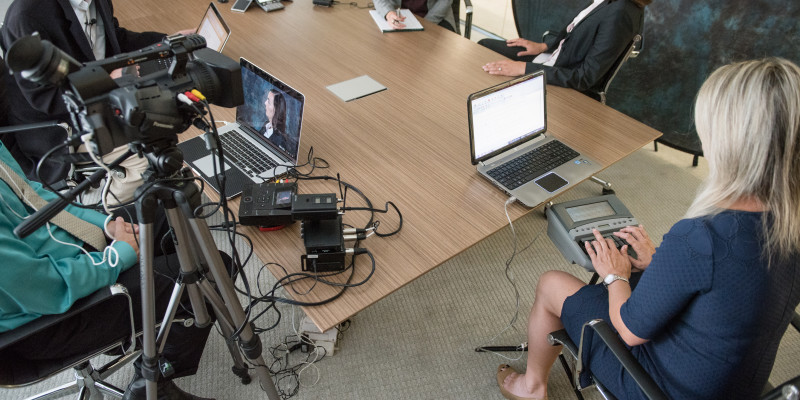
Evidence Group LLC (DEG) provides litigation support services
from complaint to verdict. The services we provide include court reporting,
legal videography, and trial consulting. Our
technological tools and expertise provide attorneys with a competitive
advantage to win trials. Owned and managed by Curt Evans, Esq., David
Wiseman and Paul Hugo, DEG brings a unique skill set and arsenal of experience
to trial. We create efficient, persuasive, and powerful presentations.
Latest
News - DEG Client Awarded $48.5 Million in Insurance Dispute
A nine-member federal jury unanimously awarded $48.5 million to Sempra Energy following a two-week federal trial against the insurance broker Marsh USA Inc. Digital Evidence Group managed all aspects of the courtroom presentation of the evidence.
Marsh was charged with breach of contract after a political-risk policy failed to cover an investment that was affected by a change in government policy in Argentina. "Sempra thought it bought the right kind of insurance policy," said Kirk Pasich, a Los Angeles-based partner at Dickstein Shapiro, who was lead counsel for Sempra. "Marsh made a mistake and the jury made them pay for the mistake."
The lawsuit stemed from an insurance policy Sempra purchased through Marsh to cover investments in two natural gas companies in Argentina. The investments were indexed to the U.S. dollar, shielding Sempra from any devaluation in the Argentine peso, but Argentina's government set aside the indexing in 2002.
Sempra’s insurance company, AIG’s National Union, refused to provide coverage, alleging that the policy did not kick in as a result of the government's action. In 2006, an arbitrator concluded the same thing, denying Sempra’s $48.5 million claim.
Sempra alleged that Marsh was fully aware of the specifics of its investment in the South American country and that it wanted coverage for the scenario that occurred. Accordingly, because the insurance policy was bought through Marsh, Sempra hired Pasich to bring suit against Marsh for professional negligence, negligent misrepresentation and breach of contract.
According to Sempra and its lawyers at Dickstein Shapiro, a more appropriate insurance policy was available but Marsh steered it to a policy that did not fully cover the company’s investments. The Los Angeles jury agreed with the assessment.
$15 Million Awarded to Remedy Contract Breach Due to Racial Discrimination
A federal jury ordered DynCorp International, a government contractor, to pay more than $15 million to a former minority-owned subcontractor, Worldwide Network Services (WWNS). With demonstrative exhibits, an extensive database of trial exhibits, and video clips prepared and displayed in the courtroom by Digital Evidence Group, WWNS's attorneys from Akin Gump persuaded the jury that DynCorp breached its contract and racially discriminated against WWNS.
In 1993, WWNS was founded and operated by two African Americans as a small shop providing technology and telecommunications services to area businesses. In 2003, it became a subcontractor to DynCorp, and its revenue grew from $500,000 to $50 million a year.
WWNS filed suit in October 2006, after DynCorp ended a relationship with it to provide services in Iraq and Afghanistan. In WWNS's place, DynCorp selected a company not owned by minorities and the two then hired many of WWNS's employees.
WWNS said it was left with millions of dollars in outstanding invoices and nearly collapsed in the aftermath. WWNS also alleged that DynCorp forced the company off the contract as part of a pattern of racial discrimination, listing several examples, including the use of a slur to describe a WWNS employee and an October 2006 party hosted by one of DynCorp's top executives shortly after the DynCorp/WWNS relationship had soured. At the party, a mocking letter purporting to be from the black president of WWNS was read in Ebonics, and a T-shirt was distributed with the imprint "I brought down WWNS and all I got was this lousy T-shirt". WWNS claimed its employees were increasingly subjected to racial epithets, banned from meetings and in some cases forced to leave Iraq. WWNS also claimed DynCorp used WWNS's status as a small, minority-owned firm to help win the lucrative government contracts.
DynCorp, however, said a contract with WWNS was not renewed because of the subcontractor's poor performance.
The jury awarded WWNS $5 million plus interest in compensatory damages and $10 million in punitive damages. Based on an earlier ruling, Judge Gerald Lee had already ordered DynCorp to pay $2 million.
DEG client Merit prevails with finding of willful patent infringement
Merit
Industries, Inc., a worldwide leader in touchscreen
entertainment devices, worked with Dickstein Shapiro and Digital Evidence
Group to obtain a favorable jury verdict in a patent infringement case
involving several patents. After a 2
week trial in the U.S. District Court for the Eastern District of
Pennsylvania before Judge Savage, the jury returned a verdict of roughly
$1.5 million, and found that defendant JVL had willfully infringed,
allowing Judge Savage to treble the damages and award attorney's fees to
Merit.
Digital
Evidence Group assisted Merit and its counsel in displaying documents,
video clips from depositions, and video screens from dozens of tabletop
video game devices the defendant had alleged were prior art invalidating
Merit's patents. "I believe it
was helpful for the jury to understand how these video games operated. Having experts testify while using the
games, with the screen being broadcast throughout the courtroom, was much
more effective than trying to explain their operation by just using figures
and drawings from the patents," said Curt Evans from DEG.
After a
short afternoon deliberation, Merit’s chief competitor was found by the
jury to have willfully violated U.S. patent laws by selling
products that use Merit’s patented technologies. Merit Entertainment is headquartered in Philadelphia, Pennsylvania
and develops and manufactures touchscreen video
game machines. With an installed base of over 250,000 touchscreen
games accounting for over 4 billion plays per year, Merit is the worldwide
leader in touchscreen entertainment devices.
Attorneys
for Merit were Ken Brothers and Gary Hoffman, head of Dickstein Shapiro’s
Intellectual Property Practice, with whom DEG also worked to secure a $500
million patent infringement verdict in Saffran v.
Boston Scientific.
$500 Million Patent Infringement Verdict, Among Largest in United States
Digital
Evidence Group's client was successful in receiving a jury verdict of
$431,867,351 for patent infringement, one of the largest ever in the United States.
The Court also awarded $69.4 million in pre-judgment interest. Bruce N. Saffran, M.D., Ph.D., had
accused Boston Scientific of infringing his patent covering drug-eluting
arterial stents. The jury found Boston Scientific's
Taxus Express and Taxus
Liberte stents infringed Dr. Saffran's
patent. The Taxus stents are sold to provide
directional drug delivery to an arterial wall once implanted, reducing restenosis, or the re-closure of an artery by scar
tissue. The drug delivered, Paclitaxel (a common
chemotherapy drug), is part of a layer coated on a bare metal stent with
the polymer SIBS. Consistent with Boston Scientific's
representations to the FDA that Paclitaxel is not
washed into the bloodstream, the jury determined
that the layer, as claimed by Dr. Saffran,
delivered the hydrophobic Paclitaxel
directionally to the hydrophobic arterial wall.
Curt Evans,
a DEG principal, commented, "Digital Evidence Group is proud to have
provided trial consulting services to Dr. Saffran
and the attorneys at Dickstein Shapiro and the Albittron
Firm. For this patent infringement case in the Eastern District of Texas,
the Court only allocated 12 hours per party to try the entire case, so it
was extremely important that the presentation to the jury was clear and
smoothly run. As a result of long hours preparing documents and witness
video, the team did an amazing job of clearly presenting a complex case to
a jury in a short period of time. When you come well prepared, the jury
picks up on that, and it bolsters the credibility of the arguments you're
making."
The jury
determined a reasonably royalty to be 8% of Boston Scientific's
U.S. sales, and 6% on
stents made in the US
but sold internationally. The case, Bruce N. Saffran,
M.D., Ph.D. v. Boston Scientific Corporation, was heard by Judge T. John
Ward in the U.S. District Court for the Eastern District of Texas. Dr. Saffran was represented by Dickstein Shapiro and Albritton Law Firm
of Longview, TX.
DEG in NBA Arbitration between NY Knicks and Coach Larry Brown
DEG
participated in an arbitration to resolve a contract dispute between Larry
Brown and the New York Knicks, held at the offices of the National
Basketball Association before Commissioner David Stern. Cablevision, parent
company of the Knicks, revealed in its third-quarter filing with the
Securities and Exchange Commission that the dispute has been settled, with
Mr. Brown receiving $18.5 million. The remainder of the
settlement terms remain confidential. Commissioner Stern also
ordered all parties not to comment publicly, as reported
by the New York Times.
$52.4 Million Jury Verdict for LG Philips May Be Tripled
On July
28, 2006, a federal jury in Wilmington,
Delaware awarded $52.4
million in damages to Digital Evidence Group's client LG Philips LCD Co.
after finding infringement of a patent relating to the manufacture of LCD
panels. The defendants were Chunghwa Picture Tubes Ltd., Taiwan's
third-largest maker of liquid-crystal displays, its parent Tatung Co. and ViewSonic.
The jury
also found that the infringement was willful, giving U.S. District Judge
Joseph J. Farnan Jr. discretion to triple damages
to more than $150 million.
Digital
Evidence Group provided many services on this case including court
reporting for a fast-track deposition schedule, legal videography,
and MPEG-1 video encoding and synchronization of video to transcripts.
After discovery closed, DEG was hired for courtroom and war room equipment
procurement and management, on-site trial consulting and video clip
creation, "hot seat" trial presentation, and graphics and 3-D
animation creation and support. The graphics and animations presented by
DEG helped the jury understand complex LCD panel technology and return a
verdict of willful patent infringement. Lead counsel for
LG Philips were Gaspare Bono and Tyler Goodwyn from McKenna Long & Aldridge in Washington, DC.
The case
is LG Philips LCD Co. Ltd. v. Tatung Co., Tatung Co. of America, Inc.,
Chunghwa Picture Tubes Ltd. and ViewSonic Corp.,
05CV292, U.S. District Court, Wilmington,
Delaware.
Applied Medical Award Enhanced to $54 Million
The U.S.
District Court in Orange County,
CA, upheld a jury verdict
that Tyco Unit U.S. Surgical Corporation had willfully infringed a patent
owned by Applied Medical Resources Corp. The patent was on a medical device
known as a trocar, used by surgeons to perform
laparoscopic surgery. Because of the jury's willfulness finding, the court,
through Judge Cormac Carney, increased the $43.5
million jury verdict by almost $11 million. Digital Evidence Group assisted
Applied Medical in trying the case.
Knobbe Martens announced the enhanced damages in
October 2004. See http://www.kmob.com/Pages/news_court_upholds_verdict.htm
Applied Medical Awarded $43.5 Million, With Possibility of Being
Tripled
Digital
Evidence Group proudly announces it assisted its client Applied Medical
Resources Corp., in procuring a jury verdict of $43.5 million. Trial
counsel at Knobbe Martens persuaded an Orange
County, California, jury to find that $43.5 million was a just award
because a Tyco Unit, U.S. Surgical Corporation, had infringed Applied's patent. The patent was on a medical device
known as a trocar. The jury also found that the
infringement was willful, allowing U.S. District Court Judge Cormac Carney to triple the damages and to award
Applied Medical its attorney fees. He has set a September 20, 2004 hearing
to decide those issues.
"I'm happy to help clients present their cases more clearly,"
said Paul Hugo, the Digital Evidence Group consultant. "I enjoy
allowing attorneys to concentrate on effective advocacy, while I handle all
of the technical details. I follow the attorney's lead to create a seamless
presentation, and Judges seem to really appreciate our role in case
preparation and presentation."
For another account of the award, see http://www.knobbe.com/Pages/news_applied_medical.htm
DEG Client Awarded $134.5 Million
Digital
Evidence Group is pleased to announce a significant victory for its client Masimo (www.masimo.com),
represented by Knobbe Martens Olson and Bear in Irvine, CA.
A jury awarded $134,528,960 finding four of Masimo's
patents relating to pulse oximetry to be
infringed, and that the infringement was willful. Masimo
was also found not to infringe its opponent's patent.
Digital Evidence Group helped the attorneys educate the jury about complex
issues of patent law and Masimo's Signal
Extraction Technology by equiping the courtroom
for an electronic trial, by preparing and using digitized deposition
testimony, and by coordinating electronic display and annotation of trial
exhibits. The case is captioned MallincKrodt,
Puritan Bennet, Nellcor v. Masimo Corporation,
and was tried in the United States District Court for the Central District
of California, Los Angeles Division, before Hon. Mariana R. Pfaelzer. Additional news about Masimo can be found at http://www.masimo.com/news/news.cfm
DEG Tobacco Case Settles for $33 Million, Plus 10-year Purchase
Agreement of $700 Million
Digital
Evidence Group, LLC was entrusted with video production and consulting work
in the case D. Lamar DeLoach et al. v. Philip
Morris USA Inc., et al. The case is one of the largest antitrust cases the
tobacco industry has seen.
R.J. Reynolds Tobacco Company agreed to settle a class action lawsuit
brought by tobacco growers and quota holders alleging a price-fixing
conspiracy. United States District Judge William L. Osteen gave the
settlement between the class and R.J. Reynolds preliminary approval at a
hearing in Greensboro, North Carolina, on April 22, 2004.
Under the terms of the agreement, R.J. Reynolds will pay the class a lump
sum of $33 million, and agreed to purchase 35 million green leaf pounds
annually of U.S.
flue-cured and burley tobacco annually for the next ten years. This tobacco
purchase obligation may generate a revenue stream of approximately $700
million over the next ten years, beginning with the 2004 tobacco crop. The
settlement is believed to be the largest antitrust settlement ever by R.J.
Reynolds in an antitrust case.
The class was represented by Howrey Simon Arnold
& White of Washington,
D.C. The lawsuit was filed in
February 2000 on behalf of tobacco growers and quota holders, who alleged
that Reynolds and other cigarette manufacturers and their leaf dealers
conspired to fix the price of leaf tobacco sold at auctions for several
years. In May 2003, Philip Morris, Lorillard Tobacco Company, Inc., Brown
and Williamson Tobacco Corporation, and several leaf dealers arrived at a
separate settlement with the growers.
Under the settlements with all defendants, the benefits to class members
include:
·
The purchase of 440 million green leaf pounds
annually for ten years and,
·
The distribution of over $200 million in cash to the
class
For further press releases, please see the following:
http://www.howrey.com/news/index.cfm?fuseaction=news&newsid=1995
http://www.rjrt.com/TI/TIlitigation_pressview.asp?postID=451
Jury Awards $62.3 Million to DEG's Client Imagexpo
In
November, 2003, a jury awarded damages to Imagexpo
L.L.C., a subsidiary of SPX Corporation, in a patent infringement suit
against Microsoft Corporation. Digital Evidence Group, LLC provided trial
consulting services to Imagexpo and its counsel Howrey Simon Arnold & White.
The jury awarded SPX's Imagexpo $62.3 million in
compensatory damages and found that Microsoft willfully infringed the
patent. The parties then settled the dispute for $60 million.
The litigation related to a complaint that SPX's Imagexpo
filed in October 2002 against Microsoft alleging that Imagexpo’s
patent related to real-time conferencing was infringed by the NetMeeting
Whiteboard feature of various of Microsoft's
products. The case was heard in the United States District Court for the
Eastern District of Virginia, Richmond Division.
For more information, see http://www.howrey.com/news/index.cfm?fuseaction=news&newsID=1768
|